News

Farewell to Felicity

At the end of last week we bade farewell to our summer student, Felicity Massingberd-Mundy, who has spent the last six weeks doing a research project in the lab. She spent much of her time measuring MOF crystallisations using this cool Raspberry Pi-controlled setup, on loan from Richard Cooper‘s lab where it was made by Katie McInally in her Part II research project two years ago. We’re looking forward to writing up some of her results to publish soon; in the meantime, we wish her all the best and good luck with the rest of her studies!

Katie McInally's turbidity cell

Hamish visits RIKEN

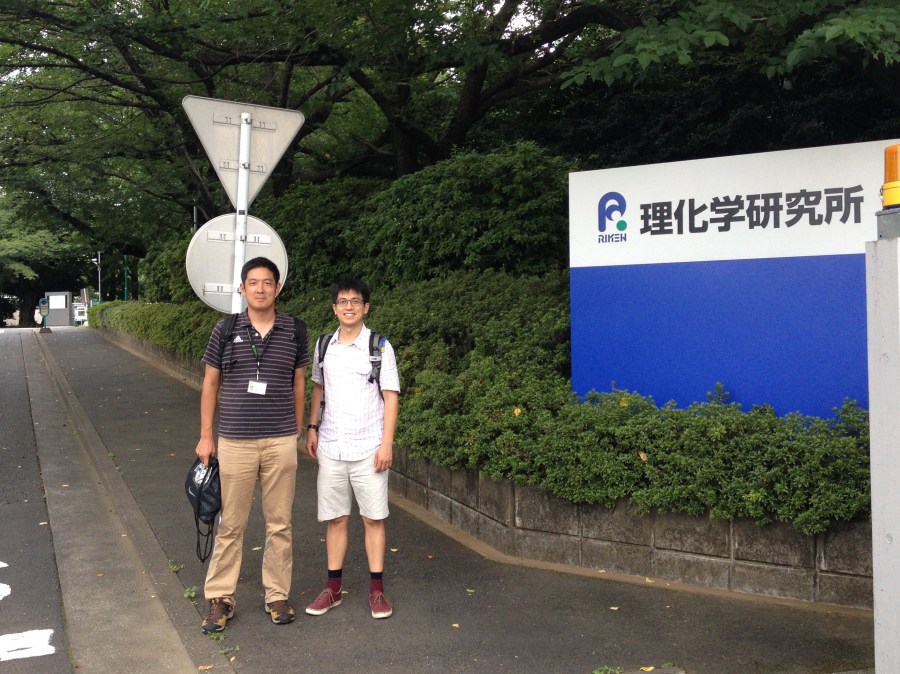
On Friday 28 July, Hamish visited his collaborators Hengbo Cui and Takao Tsumuraya at the Condensed Molecular Materials Laboratory of Reizo Kato at RIKEN in Wako, Tokyo. They study the intriguing properties of various materials made from molecules that, when assembled in crystalline form and subjected to high pressure, exhibit transitions between various electronically insulating and conducting states.

Hamish

The collaboration has involved examining the crystal structures of some of these compounds under pressure, which until now has remained undetermined except by computational methods. Hamish presented various results from the synchrotron experiment performed earlier this year, followed by discussions about how the structures link to the materials’ properties.

Hamish-Hengbo-RIKEN

We’re looking forward to writing some of these results up in the near future… watch this space!

Hamish is in Japan

Hamish has just landed in Japan to give an invited lecture at the ambitiously named “Next Generation of Optimists” workshop at the National Institute for Materials Science. It’s the first time for a year he’s been back and, despite still being bleary-eyed with jet lag, he’s really excited to be discussing new results with collaborators, catching up with old friends, and indulging in some of the local cuisine while he’s there. Bring on the sushi!

Pump priming!

We’re really happy to announce that we’ve just been awarded a small grant from the John Fell Fund, Oxford University’s main internal funding source. It will help to buy a fancy syringe pump, which will significantly improve control over our crystallisation reactions.

When crystallisation reactions happen quickly at room temperature, the order and rate at which you add reagents can be critical to achieving high purity materials, uniform particle sizes and even the desired material in the first place. A pump will not only allow us to quantify the effect of different rates, but also allow us to change reaction conditions like concentration and pH in a controlled manner in-situ.

If successful, the work will be proof-of-concept for bigger and better things: pump priming, literally!