Skip to content

Yeung Research Group at UoB

Formation, Organisation & Response of Materials

  • News
  • Research
  • Team
  • Publications
  • Teaching
  • Outreach
  • Contact

Tag: Public engagement

News

Hands-on activities to do at home!

Following on from our CCDC-funded public engagement project about MOFs and crystallisation in the summer, we have produced five activity sheets for hands-on activities that you can do at home!

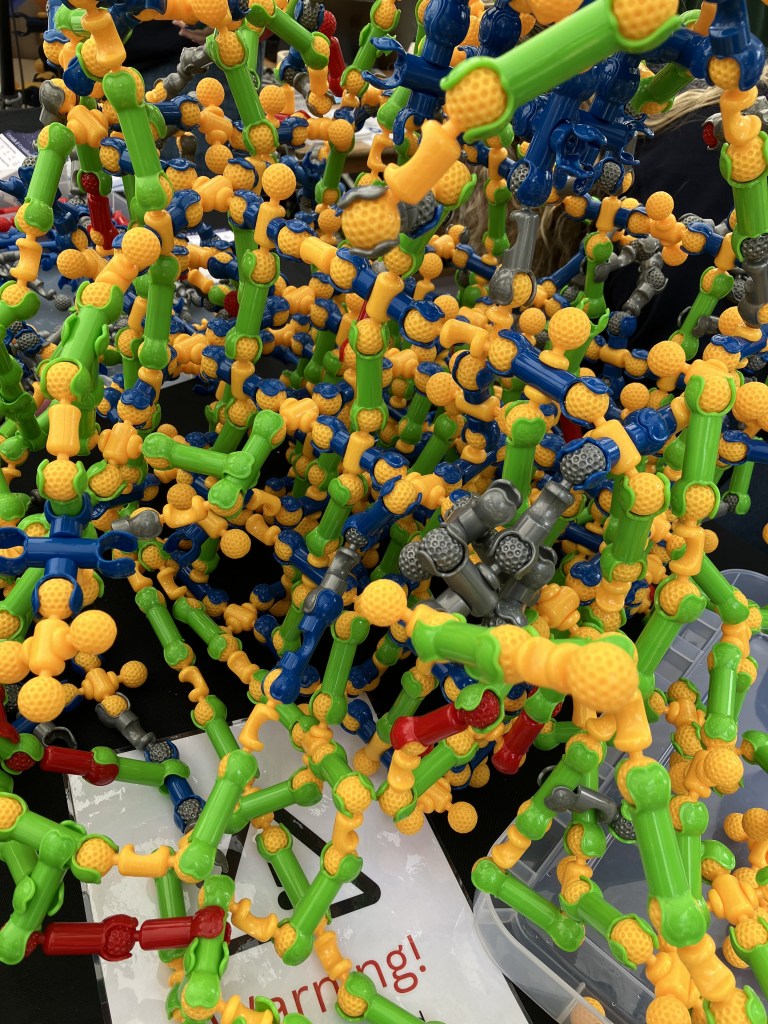
The activities are (i) Crystallisation of a magic crystal tree, (ii) Jigsaw puzzle nucleation, (iii) Magnetic tile crystals, (iv) Mineral crystals, and (v) Construction toy self-assembly.

Sounds interesting? The activity sheets can be downloaded from our Outreach pages here.

November 5, 2024December 5, 2024Crystallisation, hands-on, MOFs, outreach, Public engagementLeave a comment
News

CoCoMAD festival

This weekend we took our new hands-on outreach activities to CoCoMAD festival and it was a roaring success!

We had mineral specimens from the Lapworth museum, a growing ‘magic’ crystal tree, jigsaw puzzle nucleation, magnetic tile crystals, The Nucleation Game with live music and a giant interactive crystal that everyone got involved in helping to grow.

More information about the activities, including those you can do at home, can be found on our Outreach page.

Thanks to CoCoMAD for having us, to the CCDC and RSC for funding, to our musicians Pablo Sonnaillon and Tanguy Pocquet, to all our volunteers (Georgia, Thomas, Pat, Yomi, Sophie and Titas) and especially to our undergraduate summer interns Alice and Keyuan for developing all the activities and materials especially for the event!

July 8, 2024CoCoMAD, Crystallisation, crystals, music, Public engagement, ResearchLeave a comment
News

Pint of Science 2024

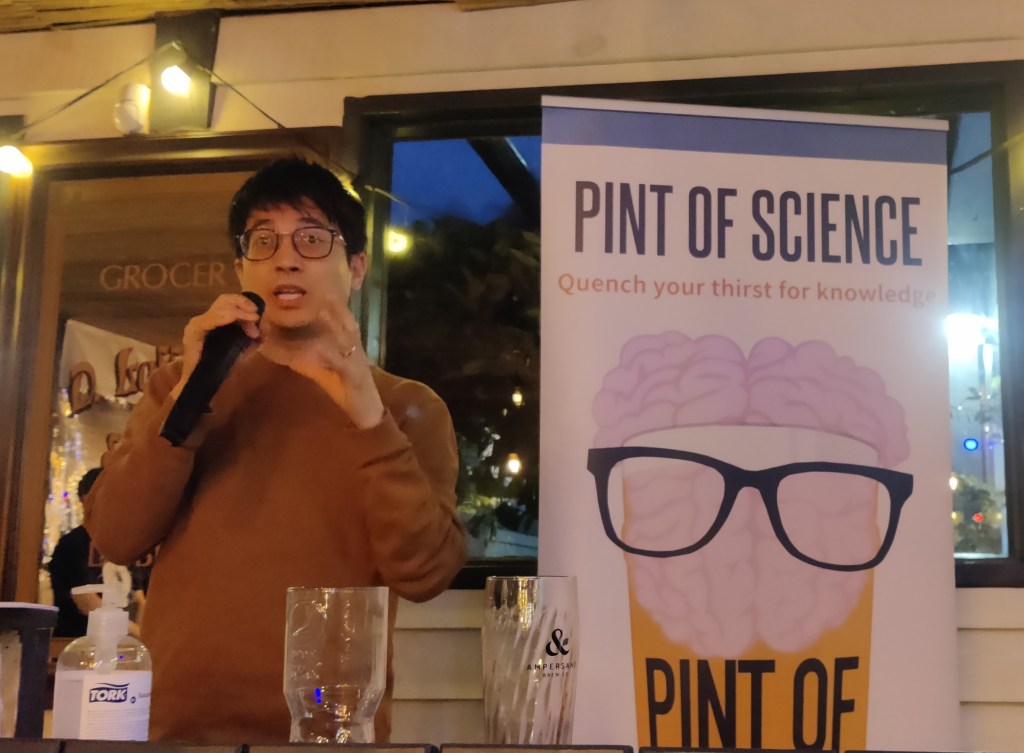
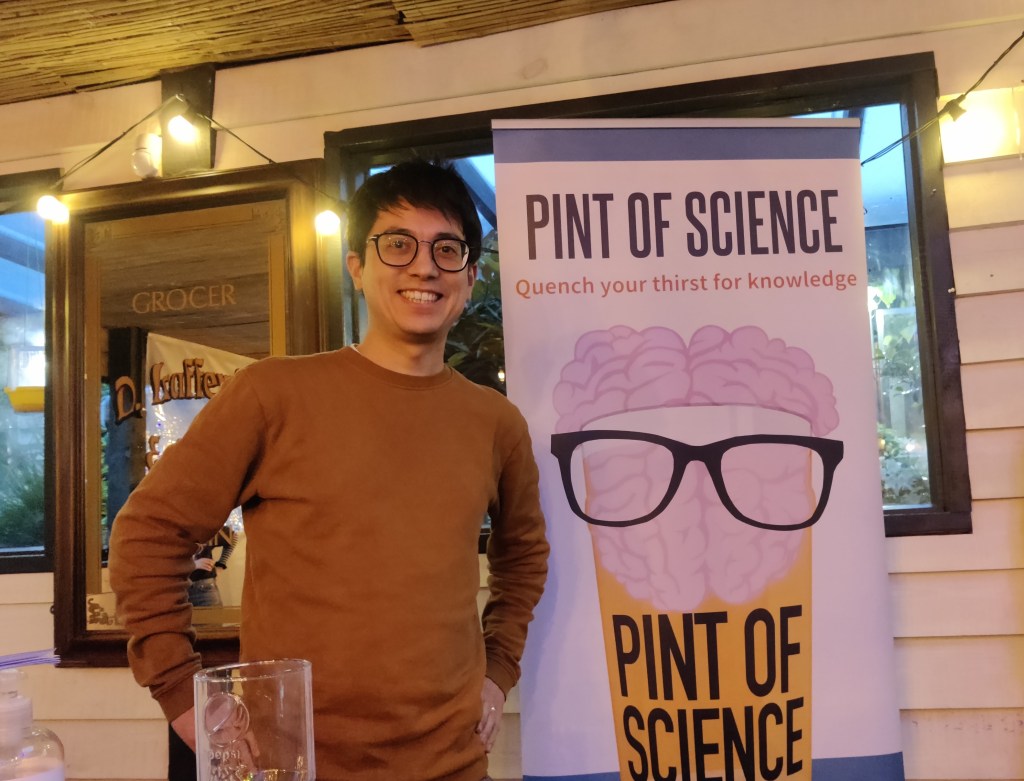
Hamish gave a talk at the Pint of Science Festival 2024, at the Hop Garden in Harborne, entitled “Order from chaos – making crystals from molecular soup”. From the programme:

Crystals are all around us, from materials and rocks to medicines and technology. They are made up of atoms and molecules arranged in regular structures, that have specific properties and behaviour. But how do they form in the first place? This talk will take you on an atomic journey from the dynamic chaos of molecular soup to the beauty, order and function of crystalline materials.

Hamish’s talk also included audio analogies to different steps in the process of crystallisation, in the form of jazz music composed by collaborator Pablo Sonnaillon. It was great to receive several questions from the audience about it, perhaps the best being “If a crystal was a type of music, what would it be?”. Answers on a postcard please!

Dark-haired man with glasses and a brown jumper speaking into a microphone, standing next to a roller banner with the Pint of Science festival writing and logo of a brain wearing glasses on top of a glass of yellow liquid.
Dark-haired man with glasses and a brown jumper standing smiling next to a roller banner with the Pint of Science festival writing and logo of a brain wearing glasses on top of a glass of yellow liquid.

May 14, 2024Crystallisation, music, Pint of Science, Public engagementLeave a comment
News, Opportunities

Outreach coming soon!

We recently hear the fantastic news that we’ve been awarded not one but two grants to produce and deliver public engagement / outreach activities! One is from the Cambridge Crystallographic Database Centre, the other is from the Royal Society of Chemistry. The activities will be in the form of activities, games and information about crystallisation, relating to our EPSRC project on MOF formation, and they will be appearing at events in Birmingham in summer 2024! It’s all very exciting but all we can say so as not to spoil the surprise is that some of the activities will be linked to a new piece of music that composer Pablo Sonnaillon has created for us…

If you’re interested in taking part, we’ll soon be looking to recruit a UoB undergraduate to help us design them, as well as a team of volunteers to deliver them at events in summer 2024!

January 15, 2024March 1, 2024CCDC, Crystallisation, MOFs, music, outreach, Public engagement, RSCLeave a comment
News

Crystals & Chemistry, Minerals & Materials – report

IMG_0065
IMG_0053

Functional Flexible Frameworks: Making Materials inspired by Minerals

Anisha Bahl (student) & Dr Hamish Yeung (supervisor)

This PER project took various models and demonstrations to the Museum of Natural History to explain to people of all ages the structures of minerals, how these have inspired the creation of new framework materials studied by the Yeung and Goodwin groups at Oxford Chemistry, and the potential uses of these materials. Two public displays were held in the Museum’s Central Atrium, where anybody could approach the stand and learn about whichever aspects interested them, and one smaller event with a youth group which took the format of a talk and hands-on discussion.

The project focussed on four minerals–zeolite, perovskite, cristobalite, and quartz–and their corresponding materials–zeolitic imidazolate frameworks, hybrid perovskites, zinc dicyanide and zinc dicyanoaurate. Whilst some of the minerals have uses of their own, in our research we are actively studying the materials, whose structures are chemically derived from the minerals, for a range of applications, including gas storage, computing, and sensing. For each mineral/material pair, we built 200,000,000:1 scale models of their crystal structures using parts custom-ordered from Cochranes of Oxford. These were juxtaposed with a beautiful sample of the mineral from the Museum’s collection (in the photo is an example of quartz), together with hands-on props designed to illustrate the connection between crystal structures and the properties of the minerals/materials. We also displayed information about the minerals’ origins and potential applications of the materials on a series of cards.

In addition to the model sets, we constructed a kit containing all the elements required for an interactive (slightly wet and messy!) demonstration of the molecular sieving properties of the zeolite/zeolitic imidazolate framework pair of models. During the public displays, this demonstration was performed every 10-15 minutes to one side of the model display, and served to direct further attention to the exhibit.

Reflections:

The project was hugely successful with the majority of the feedback showing that the participants both enjoyed and learnt from it. The verbal and written feedback both demonstrated that the information was clearly presented and at an accessible level to those viewing it. Whilst initially aimed at secondary school children, primary school children and even younger really enjoyed the display and many showed a clear understanding of some of the concepts (the photo bottom left shows siblings examining the perovskite structure). Conversely there were many adults who also gained a lot from the experience and comments that they “never understood science at school” were quickly replaced by feedback that it was “very easy to understand and interesting.” The museum also commented that they would be interested in using parts or all of the display in future events. Overall the project was considered a success in the sense that it provided a fun and interesting way for a wide range of people to engage with the Department’s scientific research.

Outcomes:

The models and demonstration are now available as an easily portable kit-in-a-box, for taking to other events, such as science fairs, festivals and schools, in the future. Please get in touch to find out more!

Many thanks to Carly Huggins-Smith and OUM, Soozy Smith (photo permission) and Hanna Bostroem, Chloe Coates & Emily Reynolds for demonstrating.

August 31, 2018October 26, 2018crystals, demonstration, hands-on, materials, metal-organic frameworks, minerals, museum, Public engagement

Posts navigation

Older posts

Search this site

Website Powered by WordPress.com.
  • Subscribe Subscribed
    • Yeung Research Group at UoB
    • Already have a WordPress.com account? Log in now.
    • Yeung Research Group at UoB
    • Subscribe Subscribed
    • Sign up
    • Log in
    • Report this content
    • View site in Reader
    • Manage subscriptions
    • Collapse this bar
 

Loading Comments...