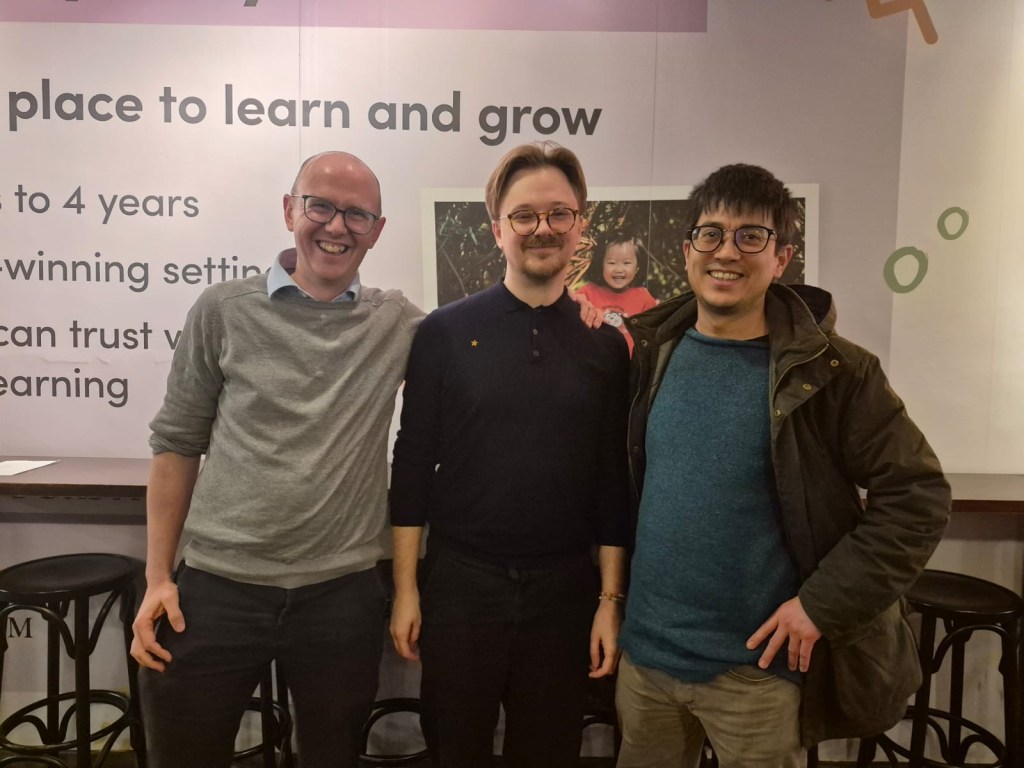
Harry passes his PhD viva

Congratulations to Harry Lloyd, who passed his PhD viva with minor corrections today!

Harry did some excellent research into the structures and properties of MDABCO-based ferroelectric hybrid perovskites, principally using single crystal methods, and made several developments to the in-situ electric field cell at Diamond beamline I19. Part of his work was published in CrystEngComm, and there should be at least one more paper to come!

Many thanks to Emma McCabe and Peter Slater for examining his thesis, and to Mark Warren and Lucy Saunders, who co-supervised Harry from Diamond Lightsource beamline I19.

Here’s a post-viva proud supervisor picture of Mark, Harry and Hamish!

PhD studentship available Oct 2022

We are excited to offer a PhD studentship to start in October 2022, on a project joint with scientists at Diamond Light Source, the UK’s national synchrotron facility. Please note that funding for fees is available for home (UK) students only and this re-advertised position will close as soon as a suitable candidate is found.

Recently, MOFs with hierarchical structure–on multiple length scales–have been created that give rise to unprecedented properties and emergent phenomena, such as structural colour. This project will develop the necessary protocols and expertise to perform and analyse tandem in-situ X-ray scattering experiments across beamlines I22 and I15-1 at Diamond, to probe the key length scales and timescales involved in hierarchical MOF formation. 

The student will spend time at Birmingham and Diamond, co-supervised by leading experts in small-angle scattering and total scattering measurements, Dr Andy Smith and Dr Phil Chater, respectively. They will have an allowance up to £3000 per year for conferences, training and travel, and will receive additional training in transferable skills such as Python, scientific writing and presentations.

For more details and to apply see FindAPhD.

New year, new arrivals

This month we are joined by Harry Lloyd and Aaron Chambers, who will be starting two exciting, collaborative PhD projects in the group!

Harry is studying time-resolved dynamics of framework materials under electric fields on a joint Diamond Light Source PhD studentship. He’ll be co-supervised by Dr Lucy Saunders and Dr Mark Warren from Diamond, where he’ll spend two years getting hands-on at Beamline I19-1!

Aaron is studying the formation and processing of MOF nanoparticle composites as part of a collaboration initiative between the University of Birmingham and BAM, the Federal Institute for Materials Research and Testing, Berlin. He’ll be co-supervised by Dr Brian Pauw from BAM, where he’ll visit to perform 3-D printing and in-depth structural characterisation.

Diamond PhD studentship

We’re really excited to offer a PhD studentship for 2020 joint with Diamond Light Source, the UK’s national synchrotron facility!

The project is funded for 4 years and the student will spend 2 years at Birmingham, 2 years at Diamond, where they will investigate how the structures of functional materials – including metal–organic frameworks and molecular ferroelectrics – change with applied electric fields.

The student will gain cutting-edge skills in materials synthesis, time-resolved single crystal X-ray diffraction and physical property measurement.

Please see the link above for more information and to register interest. Contact Hamish for any other enquiries.

Squeezing conductivity from a molecular crystal

Most molecular materials don’t conduct electricity well because the electrons in them can’t travel around easily. Materials that do conduct have pathways for their electrons, formed by overlapping atomic orbitals–the space where electrons usually stay–between molecules. In order to increase the conductivity of a molecular crystal, Nickel 5,6-dihydro-1,4-dithiin-2,3-dithiolate, we used high pressure to squeeze the molecules together.

This work was an international collaboration with some really talented scientists in the RIKEN institute, Japan, Kumamoto University, Japan, and Diamond Light Source synchrotron, UK.

Hengbo and Reizo at RIKEN made the molecular crystals and measured their conductivity under high pressure. They did this by attaching tiny wires to the crystal inside a Diamond Anvil Cell (DAC)–a device that generates pressure larger than found at the bottom of the ocean. They found that, whilst normally the crystal didn’t conduct electricity at all, when it was squeezed its conductivity increased dramatically.

In order to understand why, we used X-ray diffraction to work out the crystal structure–where the atoms are and how they are bonded together. Aided by Chloe and Mark, we fired intense X-ray beams produced at Diamond Light Source through our crystal in the DAC and measure how they scattered. From the scattering, we could show for the first time that the molecules got closer and closer together under pressure.

The final piece in the puzzle came from Takao at Kumamoto, who used theoretical calculations based on the X-ray crystal structures to work out the changes in orbital interactions. And the calculations showed that the orbitals between the molecules indeed overlapped more and more with pressure, explaining why the crystals’ conductivity got higher.

A link to the paper can be found here. It’s Open Access, meaning anyone can read it for free!

Thanks and well done to Hengbo, Takao, Chloe, Reizo and Mark!